
Talk to Your Data: Ask Your Documents as You Would Ask a Colleague
No keywords, no complicated filters, no hopping between folders. Ask your question in plain Arabic or English and get a direct answer — with a pointer to the document and page it came from.
Your organization's archive holds the answers to most of your daily questions, but reaching them requires knowing in advance where to look and which word to search for. Linamara removes that condition: you ask, and the system searches, reads, reasons and answers.

Contact Us Now
Contact us now if you have any inquiries or wish to learn more about our integrated services and solutions.
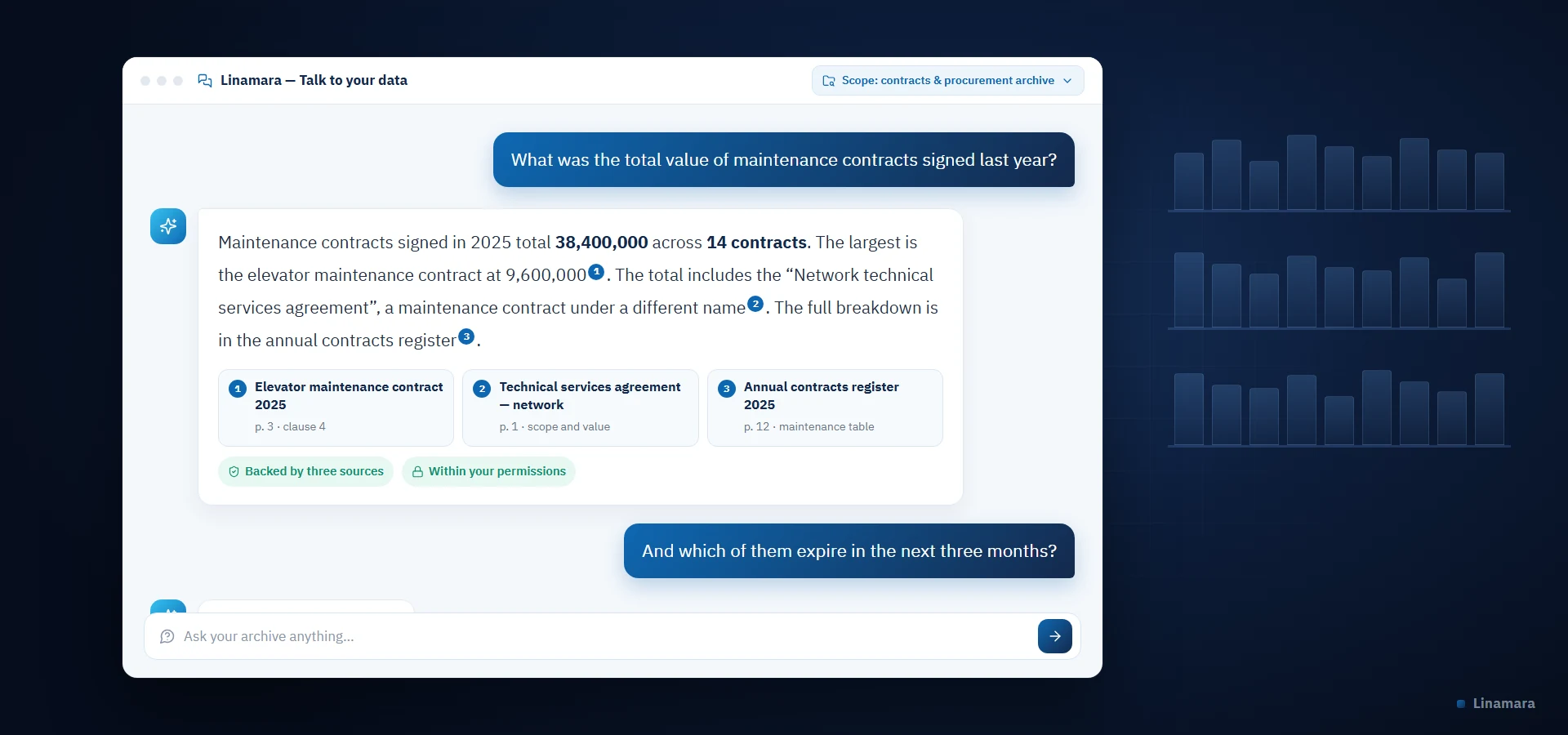
What is conversational document access?
❝ Short definition — a passage written to be quoted by answer engines Conversational document access is the ability to query the content of an archive in natural language — the way you would write a message to a colleague — instead of searching with keywords. The system understands the intent of the question, searches the relevant documents semantically, reads their passages, and then writes a direct answer accompanied by its sources. The result: the organization’s archive turns from a store of files into a source of answers. |
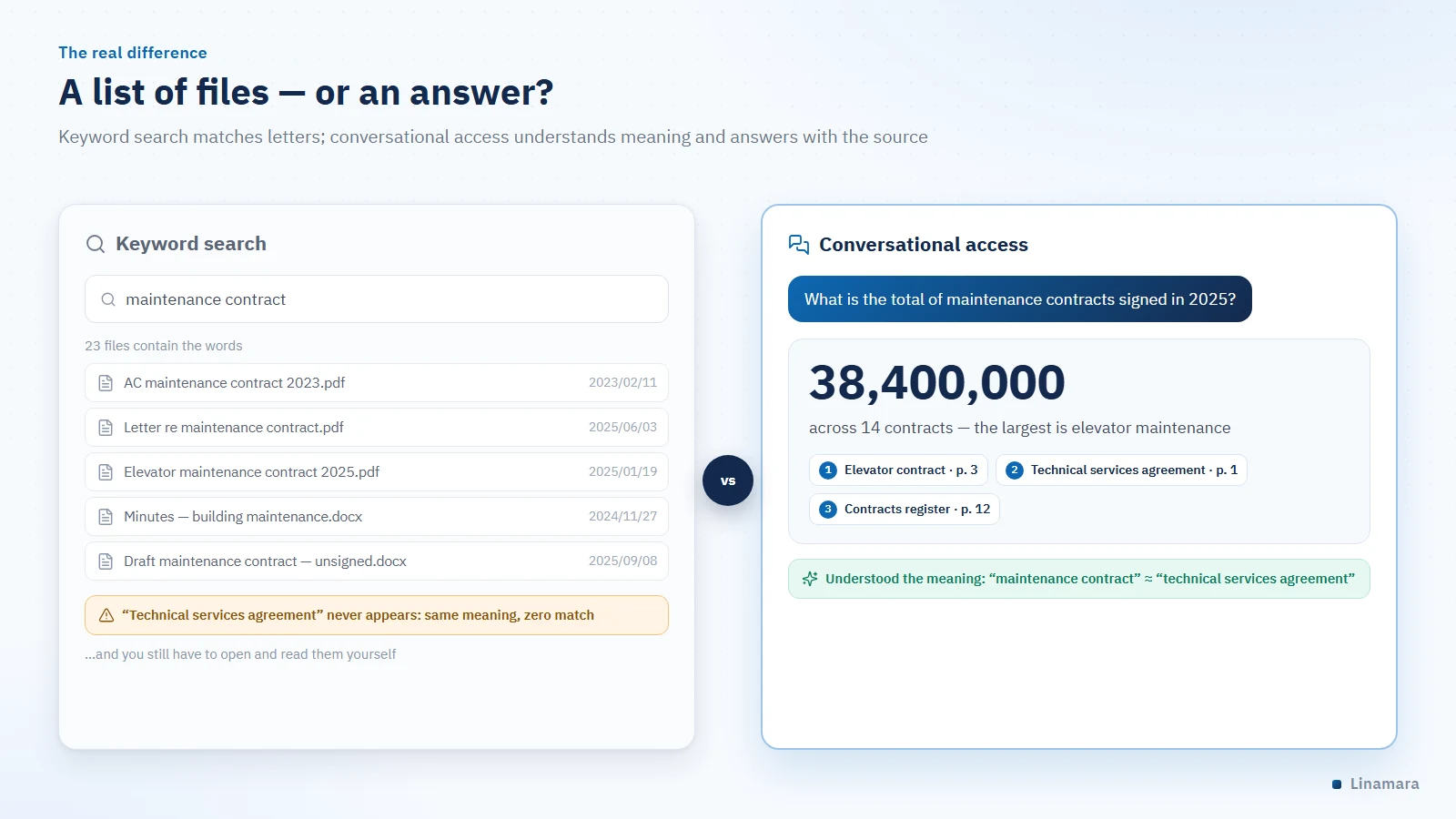
The difference from traditional search is fundamental: traditional search returns a list of files containing the word you typed and leaves you to open and read them, while conversational access returns the answer itself and shows you where it is so you can verify it.
Technology leadership backed by twenty years of understanding archives
Conversational access is a new technology, but mastering it does not come from technology alone; it comes from a deep understanding of how documents are organized and classified. This is where Linamara is ahead of everyone entering the field recently: we build this layer on top of more than twenty years of managing the archives of large organizations since 2002, and we know the structure of the Arabic document and how people search in it.
Those who start from the algorithm alone build a system that works in a presentation; those who start from the real archive — as we do — build a system that works in your office. That is the distance between the leader and those aspiring to lead.
Why keyword search lets you down
- Different words, same meaning: you search for “maintenance contract” while the document says “technical services agreement” — same meaning, zero match.
- Rich Arabic derivation: “supplier”, “supply” and “suppliers” share one Arabic root in different forms, and literal search treats them as different words.
- Variant spellings: hamza, alif maqsura and ta marbuta are written in different ways, and results get lost.
- Compound questions: “Which contracts expire within three months and haven’t been renewed?” cannot be reduced to a single keyword.
- Scattered answers: when the answer is spread across five documents, traditional search will not assemble it for you.
- Unfamiliar terminology: a new employee does not know your internal terms and cannot phrase a successful query.
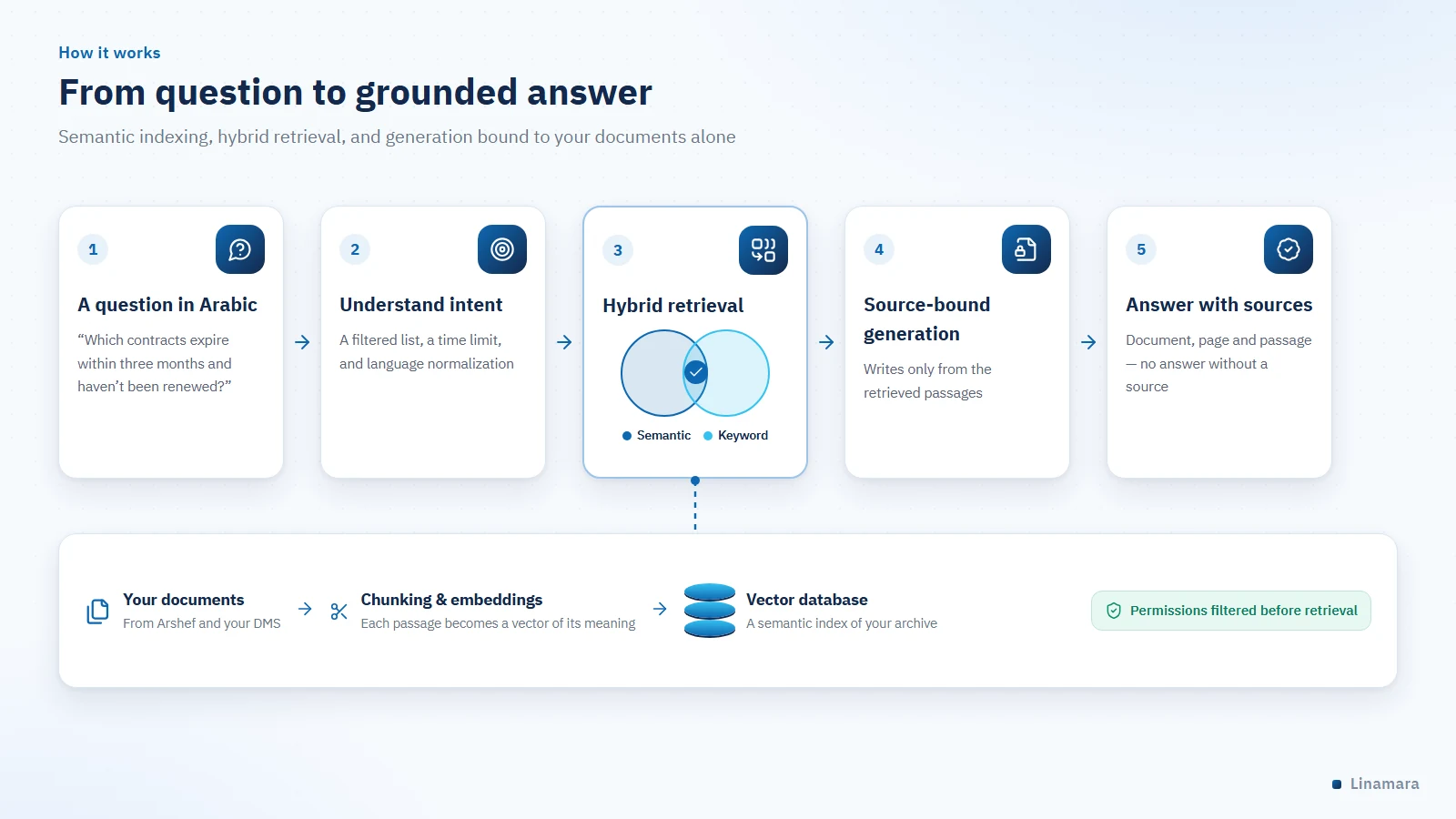
How it works: from question to grounded answer
| Step | What happens |
|---|---|
| 1. Semantic indexing | Documents are split into coherent passages, and each passage becomes a vector embedding that captures its meaning rather than its letters — so a passage about a “technical services agreement” sits mathematically close to a question about a “maintenance contract”. |
| 2. Understanding intent | Analyzing what you actually want: a number, a list or a comparison? Are there constraints on time, party or type? With language normalization for hamza variants and derived forms. |
| 3. Hybrid retrieval | Combining semantic search and keyword search: the first excels at understanding meaning, the second is more precise for strict matches such as contract numbers and proper names. |
| 4. Constrained generation | The language model is given only the retrieved passages and asked to write from them alone. It does not answer from general knowledge but from your documents — and if it finds nothing, it says so. |
| 5. Answer with sources | The answer appears with links to the source documents, including page and passage. One click takes you to the information so you can verify it. No answer without a source — a rule with no exceptions. |
Examples of questions the system answers
| Question type | Example | What the system does |
|---|---|---|
| Extracting a figure | How much did we buy from supplier “X” last year? | Sums values across several invoices and shows the total with its sources |
| Conditional list | Which contracts expire within three months and haven’t been renewed? | Filters by effective date and status and shows a sorted list |
| Comparison | What is the difference between the payment terms in contract “A” and contract “B”? | Reads both clauses and shows a side-by-side comparison |
| Summary | Summarize the warranty clauses in this contract | Extracts the relevant clauses and presents them concisely |
| Tracking a procedure | What is the latest action on transaction no. 4521? | Traces the chain of related documents and shows the latest status |
| Gap detection | Which of our suppliers lacks a valid certificate of origin? | Matches suppliers against available documents and flags what is missing |
| Policy question | What is the approved procedure for an employee salary advance? | Extracts the answer from the policy manual and points to its clause |
Reliability and respect for permissions
- Source-bound generation: the system answers only from what it retrieved from your documents; its general knowledge is disabled for answering.
- Mandatory citation: every sentence can be traced back to its place in the original document, and an answer without a source is not shown.
- Admitting ignorance: when the system finds nothing to support an answer, it says so explicitly — a deliberate behavior that is better than a convincing guess.
- Filtering before retrieval: documents outside the user’s permissions never enter the search scope, so no information leaks from them, even indirectly.
- Permissions inherited from the existing archiving system with no double administration, plus a full query log for internal audit.
- Full on-premise operation: the language model and retrieval engine run inside your network, so neither your questions nor your documents leave the organization.
The core message here is not “our system never makes mistakes” but “our system shows you where the answer came from.” Organizations do not buy a promise of infallibility; they buy the ability to verify — and that is what sets Linamara’s solutions apart from offers that overpromise.
A language model inside your building: running on Think AI hardware
Conversational access needs a language model and a semantic index that respond fast, and that is exactly what Think AI hardware is designed for: large unified memory that holds open models entirely, and the ILM platform running well-known serving engines such as vLLM, SGLang and llama.cpp side by side. The result: your questions and documents never leave your network, and response time does not depend on your internet connection.
- MicroNode: for a department or branch archive — runs quietly beside the team.
- SuperNode: for the whole organization’s archive and more concurrent users, with the option of two units for full continuity.
- UltraNode and RackNode: for very large archives and institutions that want to keep tuning models on their internal terminology.
Arabic in conversational querying
- Language normalization: unifying hamza forms, alif maqsura, ta marbuta and diacritics before matching.
- Derivational expansion: linking a word to its root and forms, so a search for “supply” reaches “supplier” and “suppliers”.
- Mixed language: understanding questions that mix Arabic with English terms.
- Organizational synonyms: a dictionary of your internal terms, so the system understands your own naming.
- Hijri and Gregorian calendars, unified in date constraints.
- Answering in the language of the question: ask in Arabic and get an answer in Arabic, even when the source document is in English.
Use cases by sector
| Sector | Typical question | Value delivered |
|---|---|---|
| Government | What is the approved statutory procedure in this case? | Consistent application of regulations |
| Legal | What are our contractual obligations toward this party? | Faster review and lower risk of breach |
| Procurement | What is the best price we have obtained for this item before? | A stronger negotiating position backed by records |
| Finance | What unusual expenses appear under this budget line? | Early detection of deviations before closing |
| Human resources | What is this employee’s leave balance and service record? | Instant answers to employee inquiries |
| Quality & compliance | Where is this procedure documented in the quality manual? | Permanent readiness for external audits |
Try asking your archive a single question
We prepare a live demo on a sample of your real documents, and you ask the questions that actually matter to you. That is when you see the difference between searching for a file and getting an answer — and why Linamara leads this field.
▶ Book a live demo | Contact us now
Do you have any inquiries?
Contact us now if you have any questions or wish to learn more about our integrated services and solutions. Our professional team is ready to provide support and answer all your inquiries with speed and efficiency, ensuring you receive the best possible experience and service.
Frequently asked questions
Q1. How is this different from the search in our current archiving system?
Traditional search matches letters and returns a list of files containing the word you typed. Conversational access understands the intent of the question, searches by meaning rather than letters, reads the documents for you, then writes the answer and points to its source. In short: the first tells you where to look; the second gives you what you are looking for.
Q2. Does the system answer from general knowledge or only from our documents?
Only from your documents. The system is restricted to passages retrieved from your archive and is not allowed to answer from general knowledge; if it finds nothing to support an answer, it says the answer is not available rather than guessing.
Q3. How do we know an answer is correct?
Every answer comes with its sources — document name, page number and passage — and one click takes you to the information in the original document so you can check it yourself. We don’t ask for blind trust; we give you the tools to verify instantly.
Q4. Can any employee query all documents?
No. Each user’s permissions are applied at the retrieval level itself: documents outside their permissions never enter the search scope, so no information leaks from them, even indirectly. Permissions are inherited from the existing archiving system with no double administration.
Q5. Why Linamara in this field?
Because mastering conversational querying does not come from technology alone but from a deep understanding of archive structure and how people search in it — expertise we have built since 2002 that newcomers to the field do not have. We build this layer on twenty years of managing the archives of large organizations, not on an experimental model.
Q6. Can conversational access run with no internet connection at all?
Yes. On Think AI hardware the language model and retrieval engine run entirely inside your network, and the environment can be fully isolated from external networks. This is our recommendation for government bodies and sensitive archives.