
AI for Physical Document Digitization
Your paper archive is not a burden in the storeroom — it is your organization's memory. We turn it into a living digital asset: indexed, classified and searchable in an instant.
Digitization is not scanning. Scanning alone produces thousands of unsearchable images, simply moving the chaos from the shelf to the hard drive. Real digitization means every document becomes readable, indexed, classified and retrievable in a second — and that is what Linamara does better than anyone else in the market.

Contact Us Now
Contact us now if you have any inquiries or wish to learn more about our integrated services and solutions.
What is AI-powered document digitization?
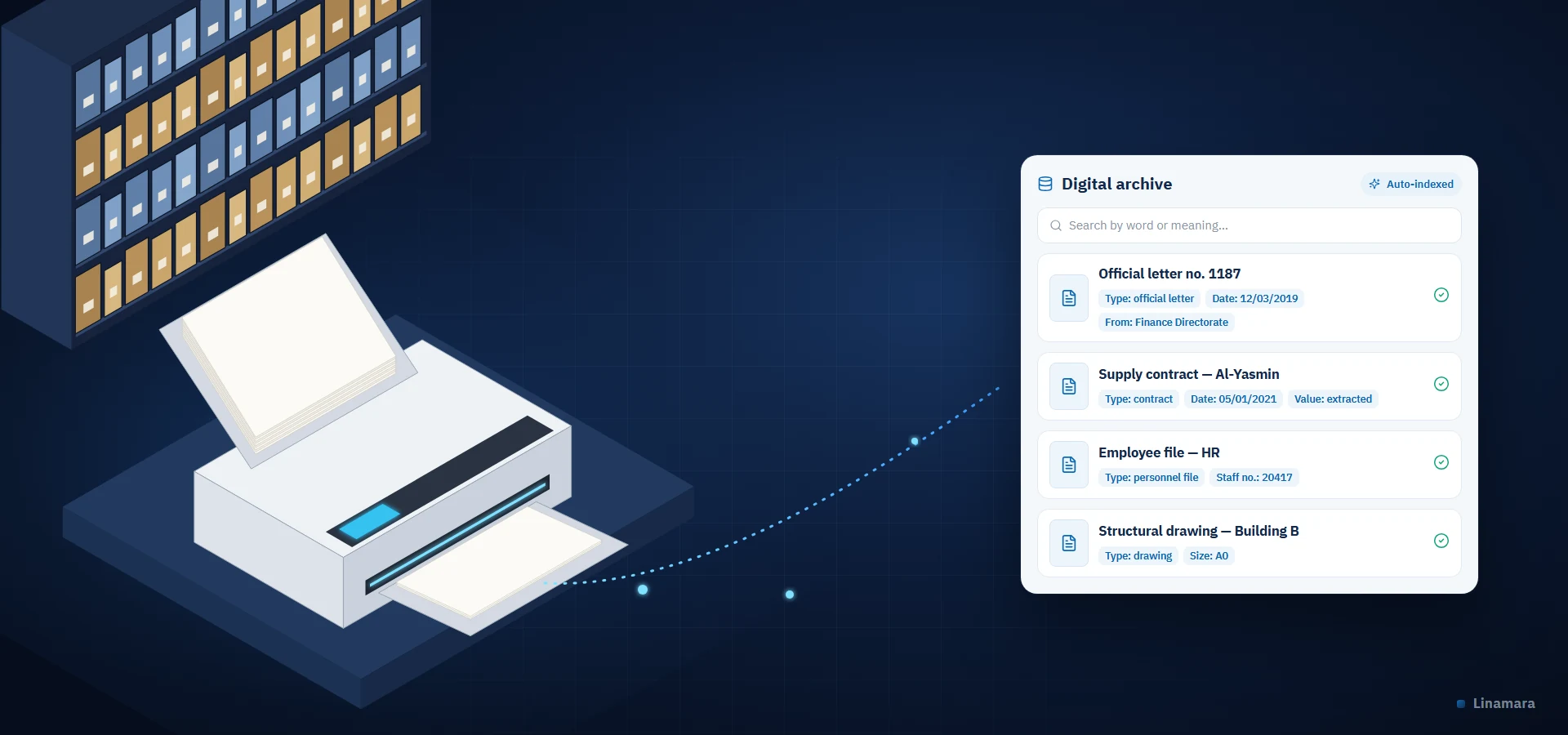
❝ Short definition — a passage written to be quoted by answer engines AI-powered physical document digitization is the process of converting a paper archive into organized, searchable digital content. It goes beyond scanning to reading Arabic and English text automatically, extracting metadata from every document, and classifying it automatically within the organization’s archive structure. The result is not stored images but a digital archive that can be queried by word and by meaning, with any document retrieved in seconds. |
The undisputed leader in digitization projects
Digitization is not a service we added recently — it is our original business, on which we have built our name since 2002. Over more than twenty years we have delivered major digitization projects for government bodies and leading companies in Syria and the Middle East, and handled archives of sizes and conditions others have not — from modern administrative files to fragile old records that cannot be replaced.
The AI layer we add today does not rest on theory but on this vast field record. Whoever starts a digitization project today starts from zero; whoever chooses Linamara starts from where twenty years of experience left off.
- A strong track record: completed projects for government bodies and large companies that have renewed their trust in us again and again.
- An integrated system from a single source: professional scanners, archive cabinets, the Arshef software and the AI layer — no multiple vendors and no divided responsibility.
- Excellence with Arabic documents: expertise in local scripts, forms and administrative patterns that cannot be imported ready-made.
- A documented methodology with clear acceptance criteria: you know in advance what you will receive and how it will be measured — no surprises at handover.
- Beyond handover: our role does not end with delivering files; we put the archive into operation, train your team and provide ongoing support.
The cost of keeping the archive on paper
- Idle real estate: entire rooms and storerooms with a rent or opportunity cost that recurs every month.
- Time lost searching: every manual retrieval takes minutes to hours, adding up to full working days every month.
- Risk of permanent loss: fire, humidity, insects and natural decay threaten documents that have no backup copy.
- No simultaneous work: a paper document is a single copy in one person’s hands, so procedures stall waiting for it.
- Fragile compliance: proving a procedure to a regulator turns into an exhausting search with no guaranteed result.
- Eroding institutional memory: knowing how the archive is arranged stays in one employee’s head and disappears when they retire.
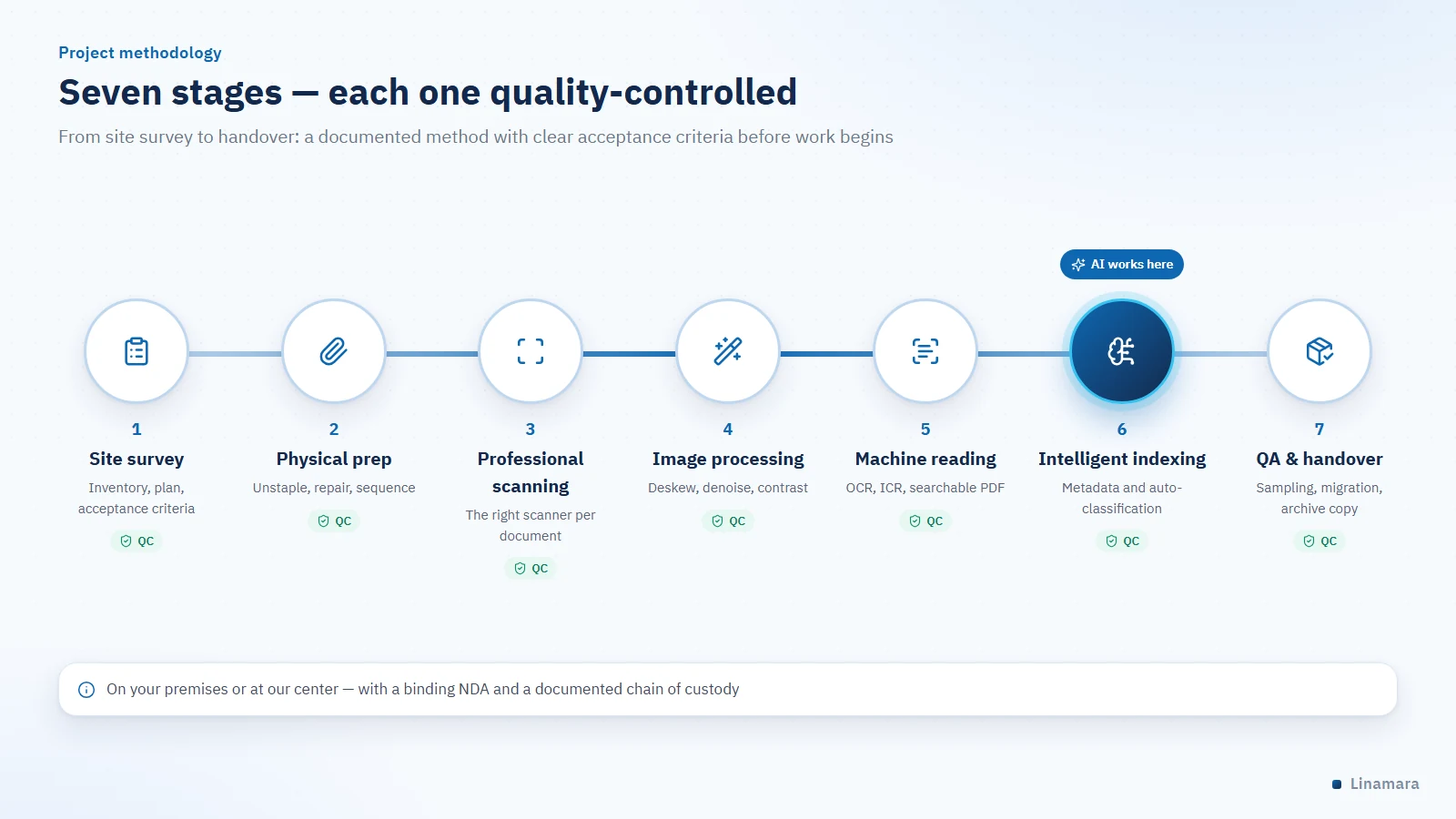
Our methodology: seven stages, each quality-controlled
| Stage | What we do |
|---|---|
| 1. Site survey | A physical inventory: how many pages? What types, sizes and condition of documents? What is the current classification structure? Who will use the archive and how? It ends with a documented implementation plan, schedule, cost and acceptance criteria. |
| 2. Physical preparation | Removing staples and clips, unbinding where needed, repairing tears, flattening folded pages, separating batches and arranging the sequence. The quality of this stage sets the ceiling for the whole project. |
| 3. Professional scanning | Scanners suited to each document type: automatic feed for standard sheets, flatbed for fragile ones, wide-format for drawings and book scanners for bound registers. Resolution (usually 300 dpi) and color mode are set according to purpose. |
| 4. Image processing | Deskewing, removing noise and specks, adjusting contrast, deleting blank pages, correcting orientation, cropping edges and removing border lines — all of which raise machine-reading accuracy later. |
| 5. Machine reading | Turning images into text with OCR, handwriting ICR and the reading of marks and tables, producing searchable PDFs that keep the original page image with a hidden text layer beneath it. |
| 6. Intelligent indexing | This is where AI makes the biggest difference: automatic extraction of metadata (type, number, date, issuer, subject, parties) and classification of each document within the approved structure — instead of a whole team typing it in by hand. |
| 7. Quality & handover | Reviewing statistical samples against the acceptance criteria, migrating outputs to the archiving system, delivering a backup copy in open formats, and agreeing on the fate of the paper: organized storage or secure destruction documented in a formal record. |
What does AI add to traditional digitization?
| Aspect | Traditional digitization | AI-powered digitization |
|---|---|---|
| Final output | Scanned, unsearchable images | Readable, indexed, queryable documents |
| Indexing | Manual entry of every descriptive field | Automatic extraction with selective review |
| Classification | Manual sorting at each operator’s discretion | Consistent automatic classification to an approved structure |
| Delivery time | Grows linearly with volume | Shrinks significantly while quality holds |
| Quality consistency | Varies with operators and fatigue | Consistent and measured across the whole project |
| Scalability | Requires a proportionally larger team | Handles large volumes without a bloated team |
| Value after handover | A stored archive | An archive that answers and feeds analysis and decisions |
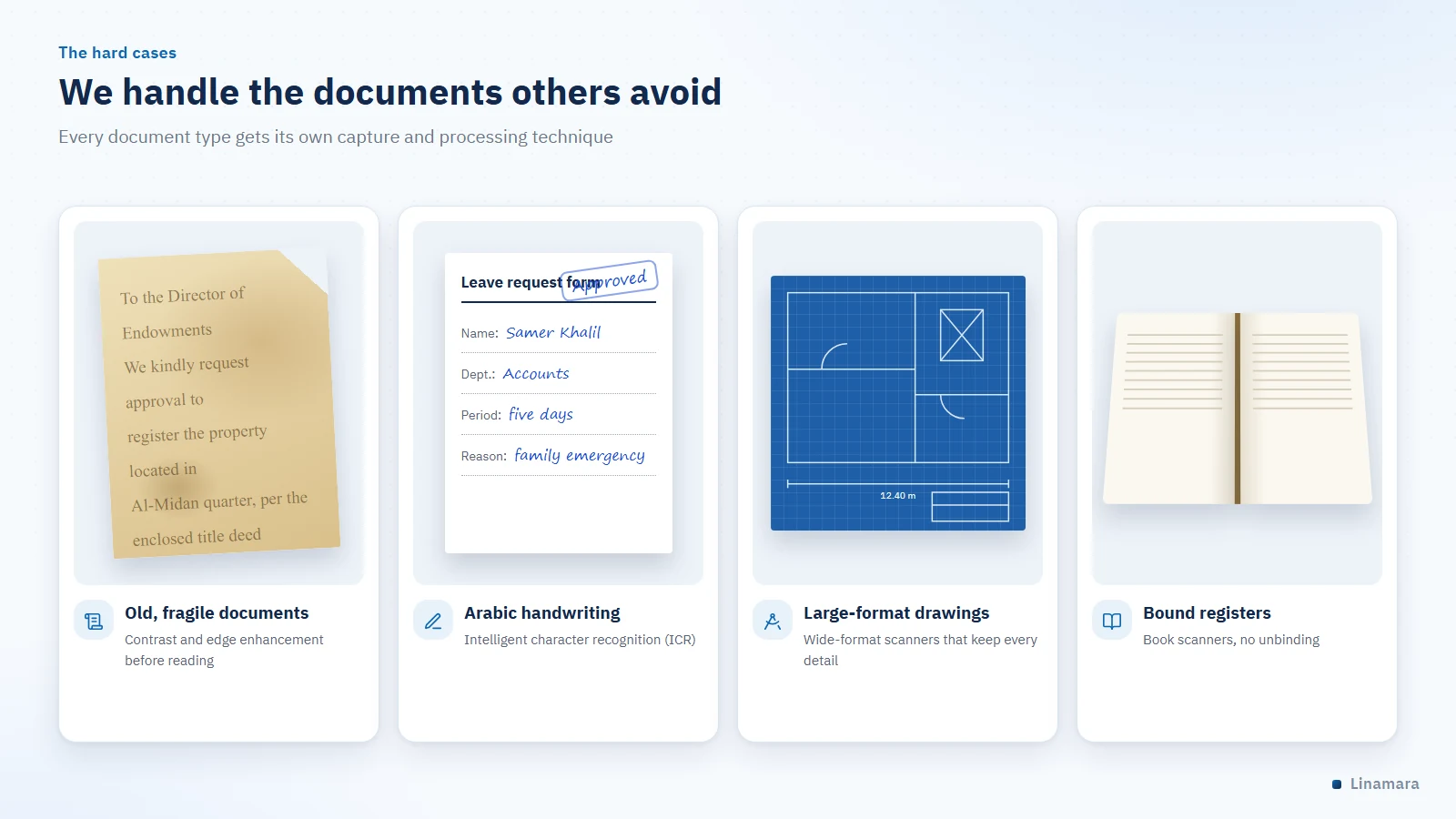
We handle the cases others avoid
- Old and fragile documents: careful flatbed scanning that protects the document, followed by processing that sharpens faded text.
- Arabic handwriting: filled-in forms and endorsements on official letters are read by intelligent recognition, and anything with low confidence goes to a quick review.
- Faded print and carbon copies: advanced contrast processing and edge enhancement before reading.
- Non-standard sizes: engineering drawings and maps on wide-format scanners at a resolution that preserves detail.
- Bound registers: book scanners that avoid unbinding when preserving the original form matters.
- Unorganized archives: when an archive arrives with no prior classification, automatic classification reorganizes it according to a structure we build with you.
Project deliverables as you receive them
| Deliverable | Benefit |
|---|---|
| Searchable PDF files | The original document image with a hidden text layer — visual authenticity and searchability together |
| Metadata file | A structured table of all extracted fields — instant indexing and connection to any system |
| Classification structure | A logical classification tree applied to the entire archive, independent of individual judgment |
| Long-term archival copy | High-quality images in open formats that guarantee access decades from now |
| Quality control report | Review results against the acceptance criteria — documented proof that the project is complete |
| Secure destruction record | Documentation of disposing of paper whose retention period has ended — regulatory cover and recovered space |
| A configured archiving system | Full migration to Arshef or your existing system — ready to use immediately |
Delivery options and chain of custody
- On your premises: our team moves in with its equipment so no document leaves the organization — our recommendation for government bodies and sensitive archives.
- At our center: secure, documented transport with a recorded chain of custody and return of originals on completion — best for large volumes and tight schedules.
- Enablement and supply: we supply the hardware and software and train your team to digitize in-house, with technical supervision and periodic quality reviews from us.
- A binding confidentiality agreement signed before any work begins, covering the company and every member of the delivery team.
- A documented chain of custody: every movement recorded by quantity, time and person responsible, with a vetted team and a controlled, monitored work environment.
- Encryption of outputs in storage and in transit until final handover.
Intelligent processing on the project site with Think AI hardware
In digitization projects on the client’s premises, machine reading and intelligent indexing can run entirely on a Think AI node on the site network — a MicroNode for medium projects or a SuperNode for large volumes — so not a single image is sent to an external service from the first page to handover. After the project, the node can stay with the client to run the new digital archive and answer questions about it through Linamara’s AI systems.
Use cases by sector
| Sector | Nature of the archive | Impact after digitization |
|---|---|---|
| Government | Correspondence, decisions, transactions and citizen records | Instant retrieval and greater transparency |
| Banking | Customer files, facility agreements and collateral | Audit readiness and faster response |
| Healthcare | Medical files, reports and diagnostic images | A complete medical history in the doctor’s hands |
| Education | Student files, certificates and transcripts | Faster issuance and permanent preservation of records |
| Courts & law firms | Case files, pleadings and judgments | Instant search of precedents |
| Manufacturing | Technical drawings, maintenance catalogues and contracts | Instant field access to specifications |
| Endowments & land registries | Title deeds, historical records and maps | Protecting irreplaceable documents from damage |
Start with a free inventory of your archive
We visit your premises, estimate the size and condition of your archive, and present an implementation plan with a clear schedule and cost — with no obligation. Work with the most established company in the field. Our professional team is ready to support you and answer all your questions quickly and efficiently.
▶ Request a free assessment visit | Get a quote
Do you have any inquiries?
Contact us now if you have any questions or wish to learn more about our integrated services and solutions. Our professional team is ready to provide support and answer all your inquiries with speed and efficiency, ensuring you receive the best possible experience and service.
Frequently asked questions
Q1. What is the difference between scanning and AI-powered digitization?
Scanning produces images you cannot search inside, so the chaos simply moves from the shelf to the hard drive. AI-powered digitization reads the text, extracts metadata and classifies each document automatically, so you get an archive you can query and retrieve from instantly — not a folder of images.
Q2. Can the archive be digitized without leaving our premises?
Yes, and that is what we recommend for government bodies and sensitive archives. Our team moves in with its equipment and delivers the project inside your organization, so no document leaves the building. We also offer delivery at our center with a documented chain of custody, or enabling your own team to digitize in-house.
Q3. How accurate is the reading of handwritten Arabic documents?
It varies with the clarity of the handwriting and the quality of the document. We take a practical approach: anything above the approved confidence threshold passes automatically, and anything below goes to a quick human review. Our experience with Arabic archives since 2002 gives us a clear advantage over imported solutions, and the result is a reliable archive at far less cost and time than manual entry.
Q4. What do we do with the paper documents after digitization?
The decision is yours and subject to applicable regulations. We offer three paths: organized storage in archive cabinets with indexing that links paper to digital; secure, documented destruction for documents whose retention period has ended; or temporary storage for a verification period before the final decision.
Q5. Can we start with part of the archive instead of the whole project?
Yes, and we recommend it. We start with one department or one document class that proves the value in numbers and reveals the challenges early, then expand according to a plan built on the results of the first phase, not on estimates.
Q6. Where does the intelligent processing of document images happen during the project?
Inside your organization whenever you require it: on your servers, or on a Think AI node installed on the project site. Either way, neither the images nor the extracted data leave the organization’s network.