
Intelligent Document Management System: An Archive That Manages Itself
No manual classification, no delayed indexing, no document forgotten along the way. The system receives the document, understands it, files it in its place and moves it to its destination — and tells you when it is running late.
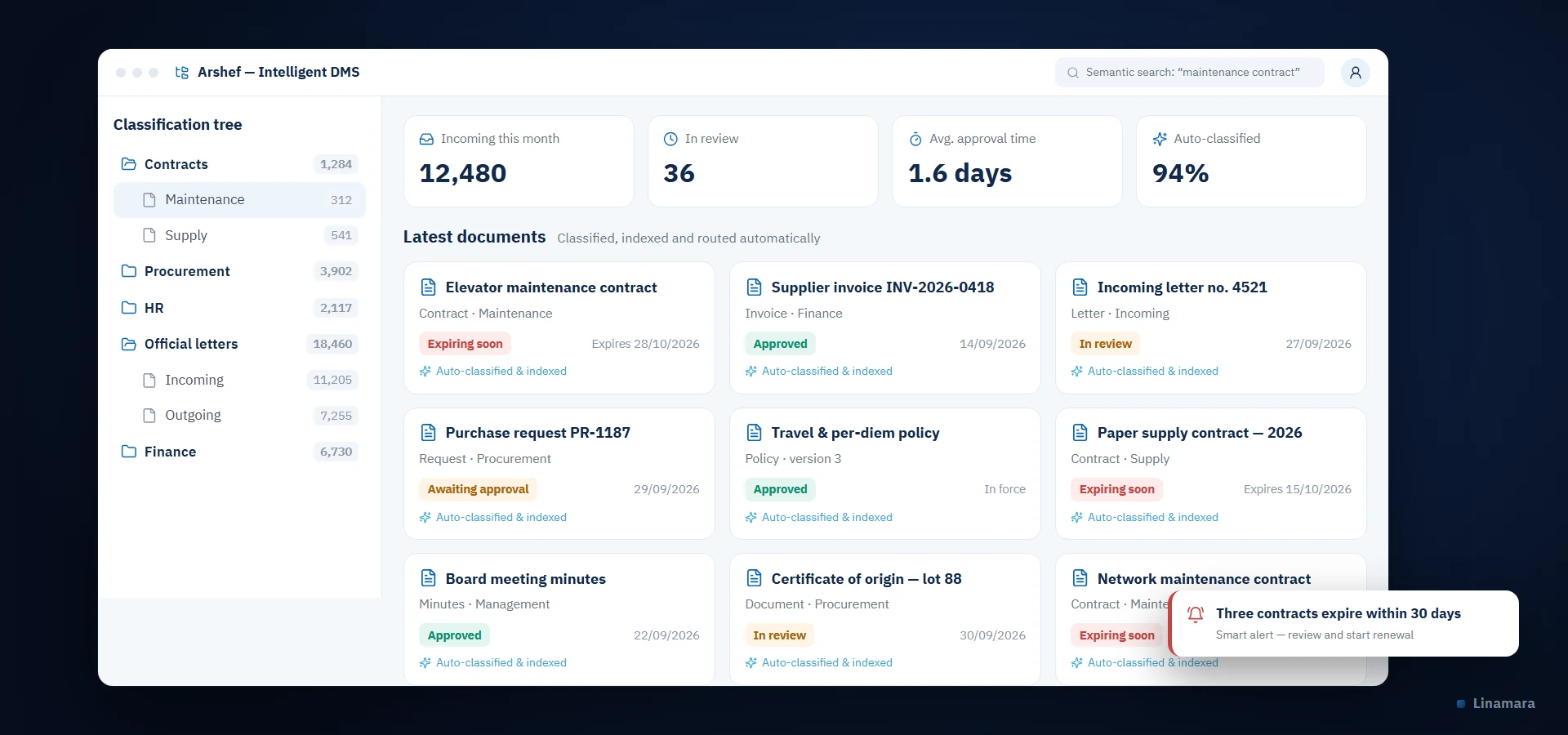
A traditional document management system is an organized digital cabinet: it stores and retrieves, but waits for you to tell it everything. The intelligent system from Linamara works it out for itself and acts on it. The difference between the two is the difference between a warehouse you manage and a colleague who works with you.

Contact Us Now
Contact us now if you have any inquiries or wish to learn more about our integrated services and solutions.
What is an intelligent document management system?
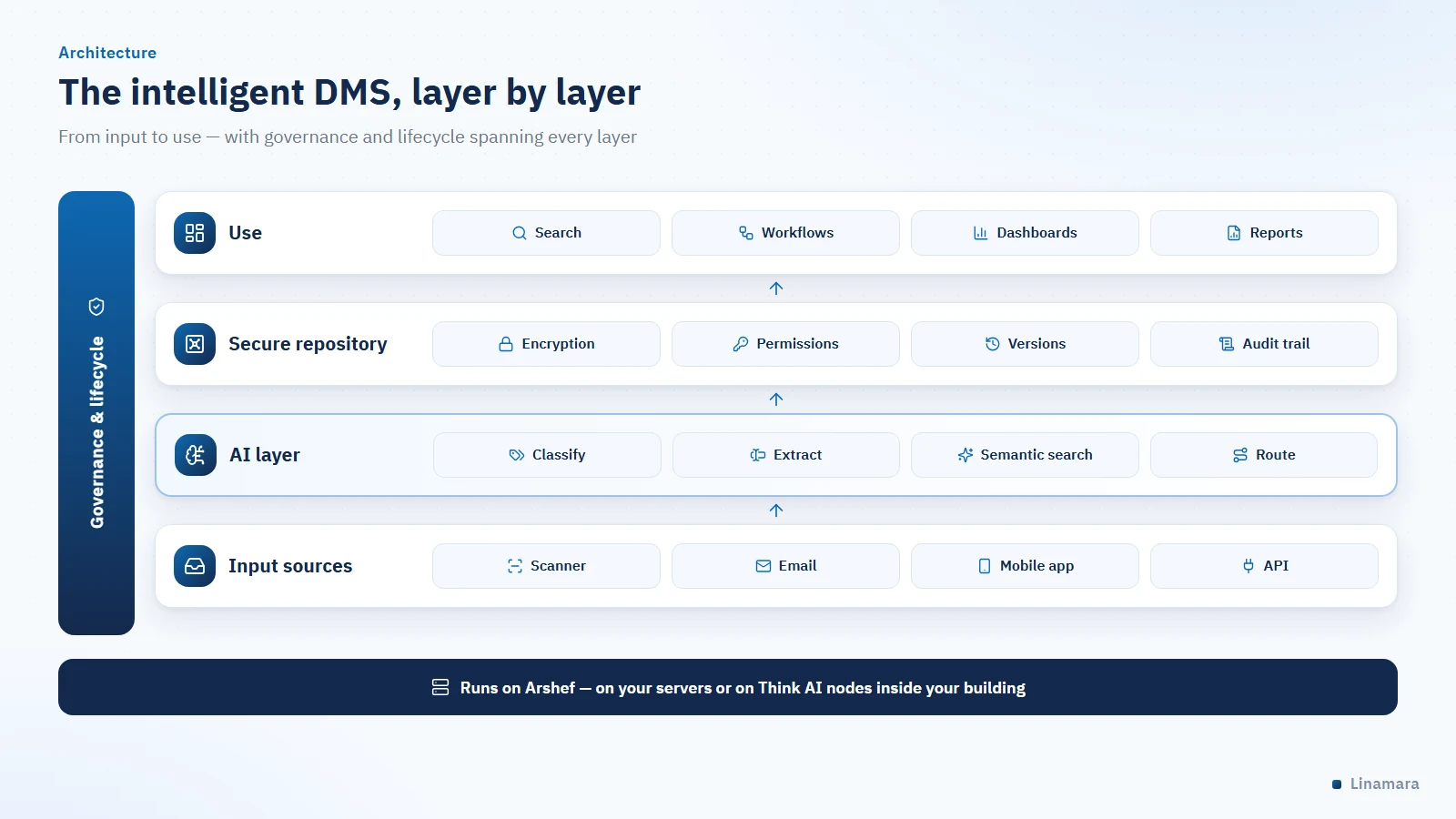
❝ Short definition — a passage written to be quoted by answer engines An intelligent document management system (AI-powered DMS) is a platform for storing and managing documents that adds to the functions of a traditional system a layer of artificial intelligence responsible for automatic classification, metadata extraction, semantic search, routing documents through workflows, and monitoring their lifecycle until archiving or disposal. The result: documents organize themselves and move by themselves, instead of waiting for an employee to classify them and chase them up. |
The impact of this shift is measured not in technology but in organizational behavior: once classification is automatic, the archive stops deteriorating over time. The biggest problem with traditional systems is not how they are built but how they gradually decay — one employee skips classification under pressure, another improvises a different name, a third postpones indexing, and two years later the organized system has become a chaotic store with an elegant interface.
From the leader in electronic archiving in the region
No one in the local and regional market has what Linamara has in this particular field. We don’t offer a document management system whose license we bought and rebranded; we offer a system we built with our own hands and have developed for more than twenty years — Arshef — which is today the choice of major government bodies and companies that manage millions of documents with it.
The AI layer we add on top is not a marketing veneer but a natural extension of a system whose every link we own: from scanners and archive cabinets to the administrative communications system and on-site digitization services. This complete, single-source integration is what makes Linamara the first choice — and no one can offer it to you in pieces with the same quality.
The eight intelligent capabilities
| Capability | What it means in practice |
|---|---|
| 1. Automatic classification | The system recognizes a document’s type from its content, not its file name, and places it in your approved classification tree. It is trained on your own categories, so classification stays consistent regardless of staff turnover or work pressure. |
| 2. Metadata extraction | The fields an employee used to fill in by hand — number, date, issuer, subject, parties and value — are extracted automatically and presented for confirmation, not entry. The biggest time saving in any document system. |
| 3. Semantic search | Search that understands meaning, not letters: search for “maintenance contract” and find the “technical services agreement”. It covers document text, metadata and scanned attachments, with language normalization for hamza variants and derived forms. |
| 4. Approval workflow automation | Automatic routing by type and content: an invoice above a threshold goes to higher approval, a leave request goes to the line manager. With alerts and automatic escalation for delays — so a transaction never stops because someone forgot it. |
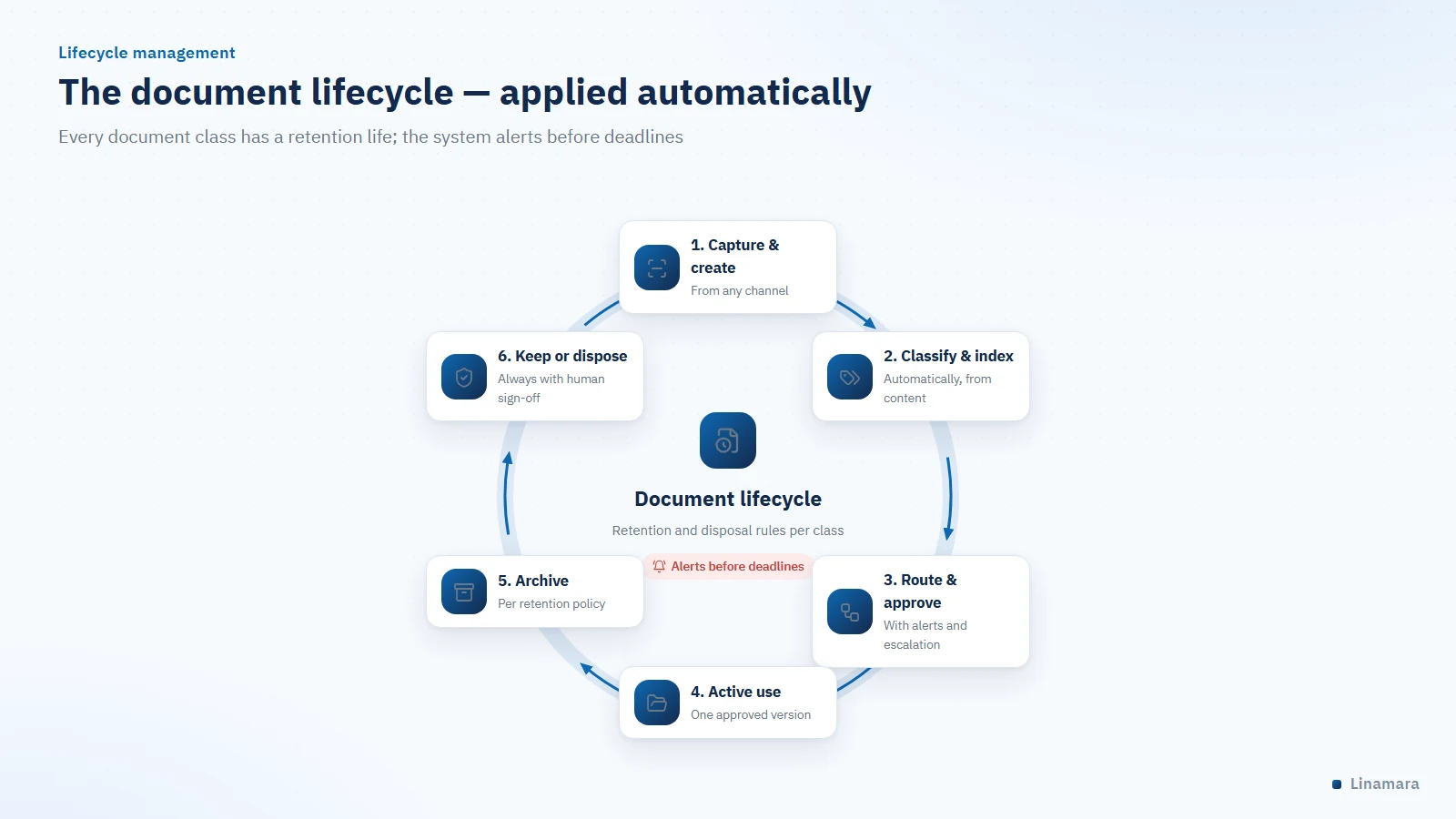
| 5. Lifecycle management | Every document class has a retention life: active, then archived, then disposed of or kept permanently. The system applies the policy automatically, alerts you before deadlines and proposes disposal when the legal period ends — always with human approval. |
| 6. Version control | One approved version of every document and a full record of every change: who changed what and when, with comparison between two versions and rollback to any earlier version. It ends the problem of conflicting copies across email and folders. |
| 7. Governance and compliance | A tamper-proof audit trail of every access, download, edit or export. For any regulatory request, the full path of a transaction is produced in a single report. The system also detects gaps proactively: incomplete files and expired documents. |
| 8. KPI dashboard | Incoming volumes, cycle times, bottlenecks, delayed transactions and department performance — so management decisions move from impressions to numbers, and problems are caught before they grow. |
Traditional versus intelligent
| Function | Traditional system | Linamara’s intelligent system |
|---|---|---|
| Classification | Manual, varies with each employee | Automatic and consistent to an approved structure |
| Metadata | Manual entry of every field | Automatic extraction with quick confirmation |
| Search | Literal keyword matching | Semantic search that understands meaning and context |
| Routing | Manual referral based on staff knowledge | Automatic routing by type and value |
| Follow-up | Depends on people remembering | Automatic alerts and escalation on delay |
| Lifecycle | Manual periodic review — or neglect | Automatic application of retention and disposal policies |
| Gap detection | When a problem or audit occurs | Proactive detection of gaps and non-compliance |
| Quality over time | Deteriorates gradually under work pressure | Improves by learning from user corrections |
Security and permissions
- Multi-level permissions: control at folder, document, field and action level — who reads, who edits, who approves and who exports.
- Roles linked to the org chart: permissions belong to the job, not the person, so they move automatically when duties change and are withdrawn when employment ends.
- End-to-end encryption in storage and in transit, and a hardened, tamper-proof audit trail that is the reference in any dispute.
- Export and print control, with a watermark carrying the user’s name and print time on sensitive documents.
- Single sign-on integrated with your user directory, with two-factor authentication.
- Backup and recovery with a periodic plan and tested procedures, plus the option of full on-premise operation on your own servers.
Integration within the Linamara ecosystem
| Integrates with | Nature of the integration |
|---|---|
| Arshef electronic archiving software | The foundation on which the intelligent layer is built, with no replacement or migration |
| Administrative communications system | Automatic entry of incoming and outgoing letters and routing within the approval workflow |
| Professional scanners | Direct capture of paper documents into the system |
| Physical document digitization services | Migrating the outputs of digitization projects — indexed, classified and ready to use |
| Conversational data access | A natural-language query layer on top of the system’s content |
| ERP and accounting systems | Exchanging invoice and purchase-order data through APIs |
| Other external systems | Open connectivity through a REST API and webhooks |
| Think AI hardware | Running the intelligent layer and its models inside the organization’s building with no external connection |
The right hardware for the size of your archive
The intelligent layer of the document management system runs on your existing servers for core tasks, while features that rely on language models — advanced semantic search, conversational querying and summarization — perform best on Think AI hardware inside the building: a SuperNode for the whole organization’s archive, a MicroNode for a department or branch, and a RackNode for data centers and large institutions.
Use cases and impact
| Sector | Key application | Impact |
|---|---|---|
| Government | Managing correspondence, transactions and approval workflows | Real-time tracking and shorter completion times |
| Banking | Customer files, compliance documents and credit facilities | Constant readiness for regulatory audit |
| Large enterprises | Contracts, procurement and administrative documents | Unified governance across branches and departments |
| Healthcare | Medical files, patient documents and insurance | Controlled confidentiality and instant access for authorized users |
| Education | Student and faculty files and academic accreditation | Readiness for quality and accreditation requirements |
| Construction & engineering | Drawings, contracts and project documents | A single approved version that prevents conflicting copies |
| Legal | Case files, contracts and statutory deadlines | Proactive alerts for critical deadlines |
See the system working on your documents
We prepare a live demo built on samples of your real documents and your approved classification structure — not on test data. Our professional team is ready to support you and answer all your questions quickly and efficiently.
▶ Book a live demo | Request a free consultation
Do you have any inquiries?
Contact us now if you have any questions or wish to learn more about our integrated services and solutions. Our professional team is ready to provide support and answer all your inquiries with speed and efficiency, ensuring you receive the best possible experience and service.
Frequently asked questions
Q1. Do we have to replace our current archiving system?
Not necessarily. The intelligent layer is built on top of your existing archiving system and adds automatic classification, automatic extraction and semantic search. We prefer this path because it protects your previous investment and reduces resistance to change. Full replacement is considered only when the current system is structurally unable to cope.
Q2. How does the system learn our own classifications?
Through a setup phase in which we build your approved classification tree and train the model on samples of your actual documents. After go-live, learning continues: every correction a user makes feeds the model, so accuracy improves gradually without any programming.
Q3. Can the system run inside our network with no external connection?
Yes. We offer full on-premise operation on the organization’s servers, including the AI models, so no data leaves your network — our recommendation for government bodies and sectors subject to data-sovereignty restrictions. Cloud and hybrid deployments are also available.
Q4. How is this different from organized folders on the network?
Shared folders only provide storage: no fine-grained permissions, no version control, no audit trail, no approval workflows, no search inside scanned documents and no retention policies. Above all, they inevitably deteriorate because their organization depends on every user’s discipline, whereas the intelligent system enforces organization automatically.
Q5. Why choose Linamara’s system over others?
Because we don’t sell the license of a system we bought and rebranded, but a system we built ourselves and have developed for more than twenty years — Arshef — trusted by major government bodies and companies. And because we own every link of the ecosystem from a single source: scanners, archive cabinets, the administrative communications system, digitization services and the AI layer — an integration no one can offer you in pieces with the same quality.
Q6. Are our current servers enough to run the intelligent layer?
For automatic classification, extraction and search, in most cases yes. To run language models in-house for conversational querying and the assistant, we recommend a dedicated Think AI node that provides the necessary accelerator memory and works in an office or server room without special cooling equipment.