
AI Hardware by Think AI: A Data Center, Condensed into One Node
Four liquid-cooled compute nodes with the ILM platform pre-installed — from a whisper-quiet desk-side node to an eight-accelerator rackmount unit. Data-center density, without the data center.
AI systems need compute, and the real question is: where does it run? An external cloud means your documents leave the building; conventional air-cooled servers need an equipped room, a raised floor and chilled water. Think AI hardware, provided by Linamara, solves the equation: a sealed liquid-cooling loop inside the node itself and an intelligent operating platform pre-installed, so it works wherever your organization works — in the office, the lab or the rack row.

Contact Us Now
Contact us now if you have any inquiries or wish to learn more about our integrated services and solutions.
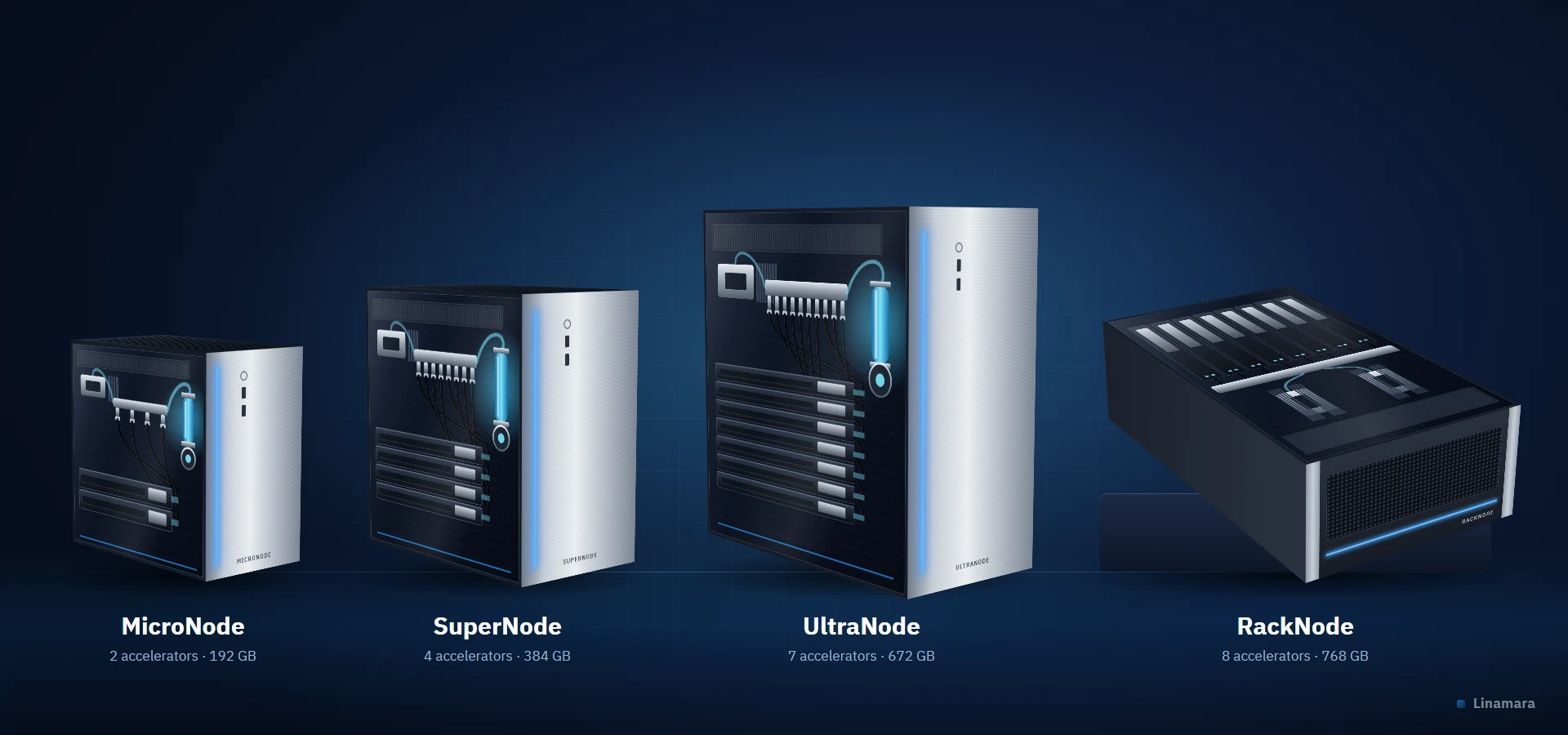
What is a dedicated AI compute node?
❝ Short definition — a passage written to be quoted by answer engines A dedicated AI compute node is a machine that combines specialized graphics accelerators, large memory, a processor and fast storage in a single chassis, with software that runs and trains language models. Think AI nodes are distinguished by a closed liquid-cooling loop inside the chassis, delivering data-center-class compute density without the need for data-center infrastructure. |
The practical result: you run open language models and Linamara’s AI systems inside your organization, with full ownership of the hardware and the data, and without paying the cloud’s price with every question.
The family at a glance
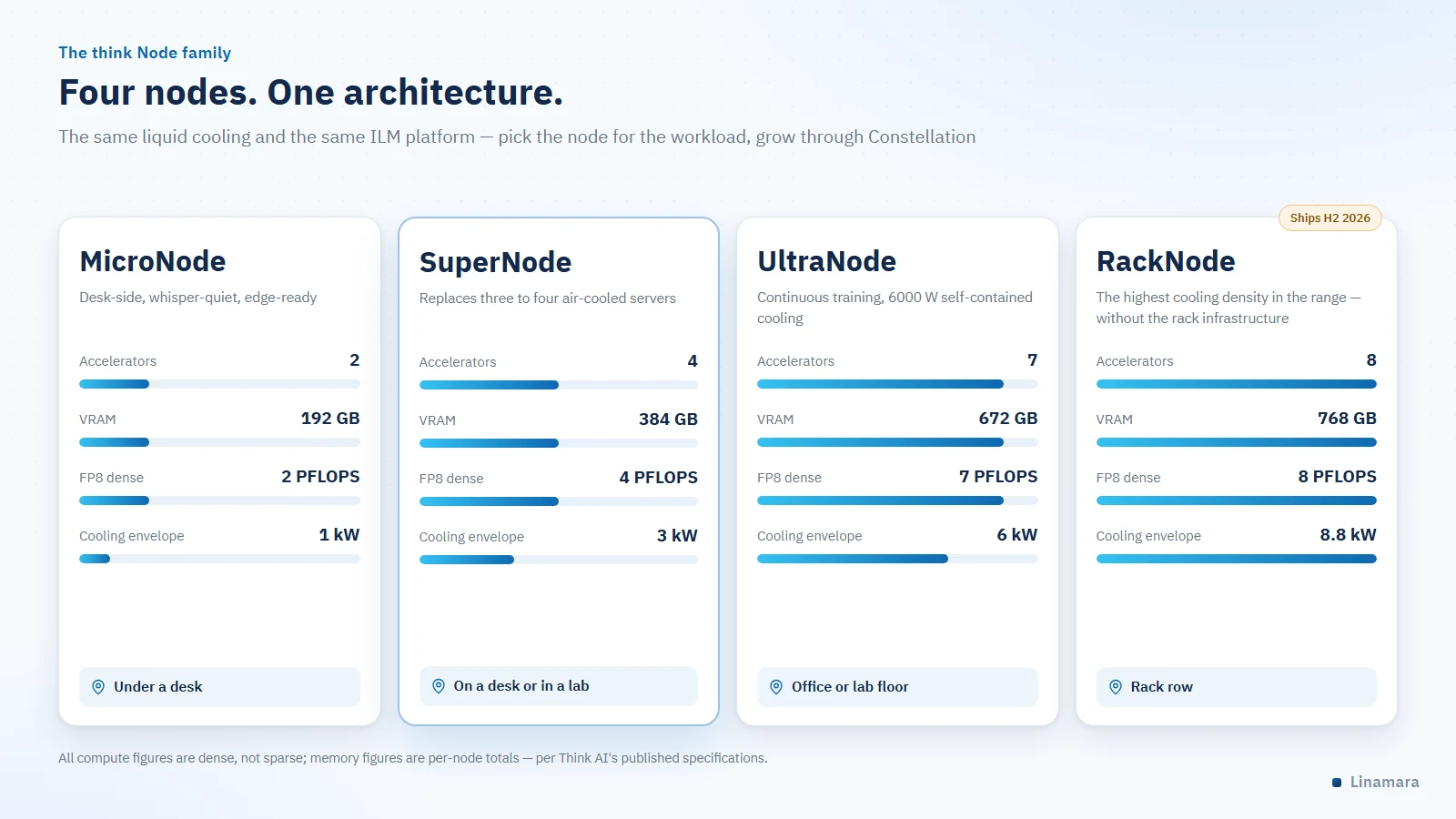
| Item | MicroNode | SuperNode | UltraNode | RackNode |
|---|---|---|---|---|
| Accelerators (NVIDIA RTX PRO 6000) | 2 | 4 | 7 | 8 |
| Total VRAM | 192 GB | 384 GB | 672 GB | 768 GB |
| FP8 compute (dense) | 2 PFLOPS | 4 PFLOPS | 7 PFLOPS | 8 PFLOPS |
| Processor | Ryzen 9 9950X | Threadripper PRO 9985WX | Threadripper PRO 9995WX | 2 × EPYC 9575F |
| System memory | 256 GB | 512 GB | 1 TB | 1.5 TB |
| Storage (NVMe Gen5) | 2 × 8 TB | 4 × 8 TB | 4 × 8 TB | 4 × 8 TB |
| Cooling envelope | 1 kW | 3 kW | 6 kW | 8.8 kW |
| Where it lives | Under a desk | On a desk or in a lab | Office or lab floor | Rack row |
| Availability | Available to order | Available to order | Available to order | Shipping from H2 2026 |
All compute figures are dense, not sparse, and memory figures are per-node totals — per Think AI’s published specifications (v1.4).
Liquid-cooled by design
Most machines spend their power moving air; Think AI nodes move heat. One sealed enclosure, one liquid loop, one operating layer — engineered together as a single system:
- No facility water: the entire cooling system lives inside the chassis; nothing is plumbed into the building.
- No raised floor, no special room: an office, a lab or a rack row — the node works wherever you put it.
- Direct-to-chip cooling: a cold plate on every accelerator and on the processor too, so under sustained full load the chip stays only about 15–20 °C above room temperature.
- Serviceable under load: no-spill quick-disconnect couplings and active leak protection; a card can be removed without draining the node.
- 7× the thermal density of a data-center rack, measured across true system volume — per the manufacturer’s figures.
- Four patents pending at the manufacturer.
Three layers, one fabric
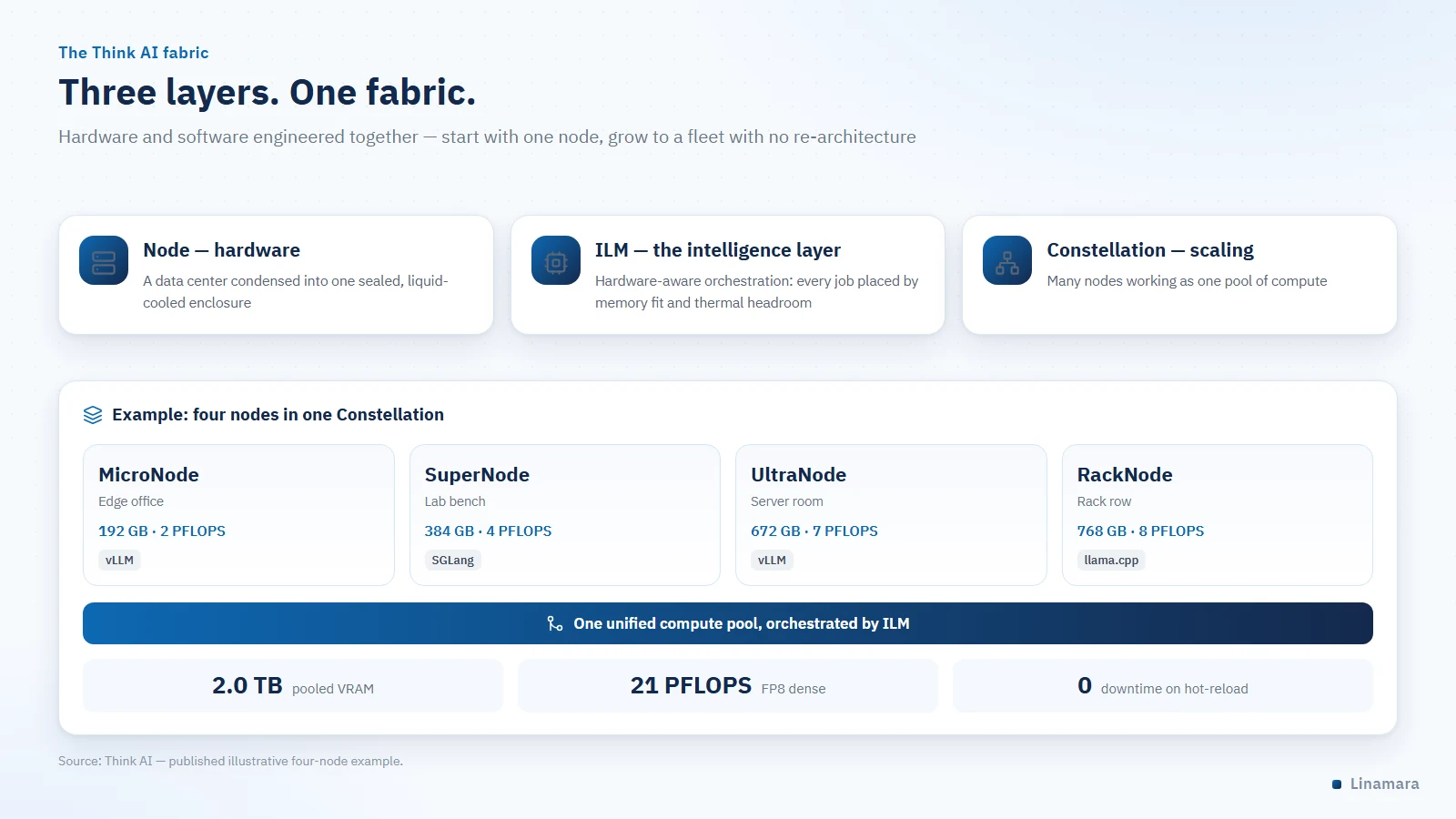
Node is the hardware, ILM is the intelligence layer that runs it, and Constellation pools nodes into a single compute cluster. Each layer stands alone; together they make the fabric:
- The ILM platform (Intelligent LLM Management): pre-installed with a one-year license on every node. It places every job by available memory and real thermal headroom, so models share an accelerator, large models are sharded across several, and training runs beside serving. It runs well-known engines such as vLLM, SGLang and llama.cpp, and training tools such as Unsloth, Hugging Face and LlamaFactory.
- Fine-tuning on your data: with SFT, LoRA and QLoRA on the very node that serves your users — something closed model APIs, whose weights you never hold, cannot offer.
- Constellation: links any mix of nodes into one pool; in the manufacturer’s example, four nodes run with 2.0 TB of pooled VRAM and 21 PFLOPS, with zero-downtime reconfiguration.
- Measured efficiency:3% sustained utilization under multi-model load, against 30–50% in most compute clusters — per Think AI’s measurements.
Why run AI on hardware you own?
- Sovereignty: documents, prompts and models never leave the building, and the environment can be fully air-gapped.
- Cost: producing answers on hardware you own costs far less than calling cloud models for every question — the manufacturer estimates about one-tenth.
- Customization: a model whose weights you own can be trained on your contracts, records and language.
- Performance: response times that do not depend on the quality of your internet connection.
The Linamara systems it runs
| Linamara system | What it gains from Think AI hardware |
|---|---|
| AI document processing | Reading, understanding and extraction with models running in-house at high speed |
| Talk to your data | A language model and semantic index inside the building for instant answers |
| Physical document digitization | Machine reading and intelligent indexing on the project site, without sending images outside |
| Intelligent document management system | Automatic classification and semantic search on the organization’s own infrastructure |
| AI assistant | Open models fine-tuned on the organization’s terminology |
What Linamara provides
- Sizing: we work out the right node with you from your models, volumes and number of users — and show the calculations.
- Supply and installation: delivery, installation and commissioning on your site.
- Integration: connecting the node to Linamara’s AI systems, to Arshef and to your existing systems.
- Training and support: training for your team and direct local support, with the manufacturer’s warranty: 3 years on hardware and 1 year of software support, with Premium and Mission-Critical service levels on request.
Book a sizing session
Tell us the models you want to run and your expected usage, and we will specify the right node — or set of nodes — with detailed calculations, then prepare your quote.
▶ Request a quote | Book a sizing session
Do you have any inquiries?
Contact us now if you have any questions or wish to learn more about our integrated services and solutions. Our professional team is ready to provide support and answer all your inquiries with speed and efficiency, ensuring you receive the best possible experience and service.
Frequently asked questions
Q1. What is the difference between the four nodes?
The architecture is the same in all four: the same liquid cooling and the same ILM platform. The difference is scale: MicroNode with two accelerators for a department office, SuperNode with four for enterprise production workloads, UltraNode with seven for large volumes and continuous training, and RackNode with eight in a rackmount chassis for data centers.
Q2. Do we need a data center to run them?
No. The cooling is entirely inside the node, so there is no need for facility chilled water, a raised floor or special air conditioning. The tower nodes work in an office or lab, and the RackNode installs in a standard rack with no additional cooling infrastructure.
Q3. Can we start with one node and expand later?
Yes. Every node is Constellation-ready from day one, so you add new nodes to the same pool without re-architecting — and you can combine different nodes in different locations.
Q4. What software comes with the hardware?
Every node ships with the ILM platform pre-installed and a one-year license; it runs and trains open models and monitors performance. Linamara’s AI systems run on top of it, according to what your organization chooses.
Q5. How do we get a quote?
Through the “Request a quote” form or a sizing session: the price depends on the chosen configuration, service level and installation requirements, and we prepare it for each organization according to its actual needs.