
AI Assistant: Grounded Answers, Not Confident Guesses
An assistant that knows your organization's documents alone, answers from them alone, and shows you the source of every statement it makes — so you can verify it yourself rather than trust it blindly.
General-purpose assistants know everything about the world and nothing about your organization; ask them about an internal policy or a clause in your contract and they will confidently answer about something else entirely. Linamara's assistant works the other way round: its knowledge is your archive, and every sentence it says is backed by a document you can open and check.

Contact Us Now
Contact us now if you have any inquiries or wish to learn more about our integrated services and solutions.
What is an enterprise AI assistant?
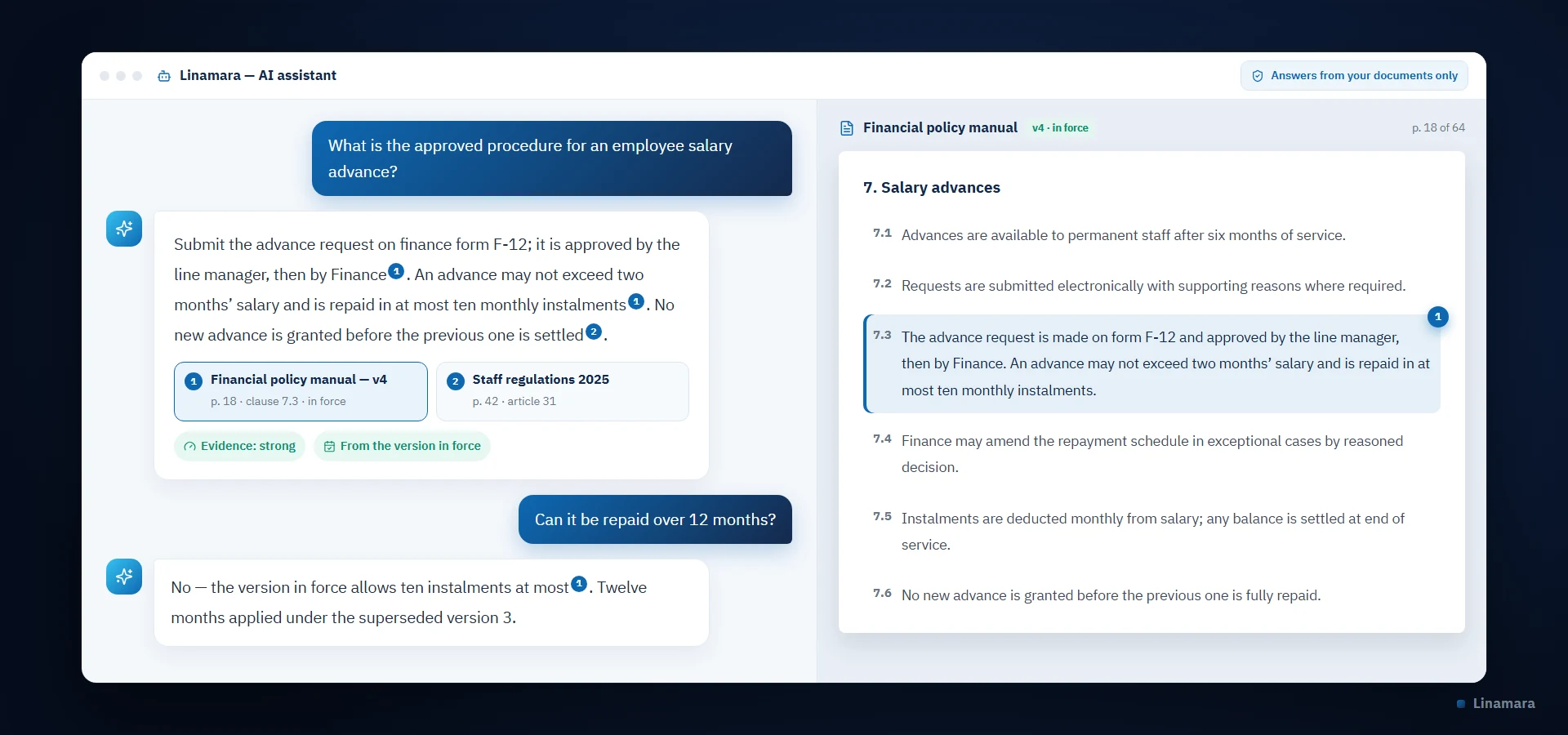
❝ Short definition — a passage written to be quoted by answer engines An enterprise AI assistant is an intelligent interface that works exclusively on your organization’s documents and data. It takes users’ questions in natural language, retrieves the relevant passages from the archive, and then writes a direct answer that cites its sources — document name, page number and paragraph. It does not answer from general knowledge but from the organization’s content alone, and it says an answer is unavailable when it finds nothing to support it. |
That last trait — the ability to say “I don’t know” — is the most important difference between an enterprise assistant and a general one. In an enterprise context, a wrong answer delivered with confidence is more dangerous than no answer at all, because decisions are built on it.
Why Linamara leads this field
Building an assistant that answers accurately is not a matter of the language model but of the archive. The language model is available to everyone today; what not everyone has is the experience that makes an archive ready to be questioned. This is where Linamara leads without rival: more than twenty years, since 2002, of organizing, indexing and classifying the archives of large organizations.
We build the assistant on top of our complete ecosystem — from paper digitization to Arshef to the semantic query layer — not on a fragile integration of disparate tools. That is why our assistant actually works in your organization, not only in the presentation.
What does the assistant actually do?
| Task | What it delivers |
|---|---|
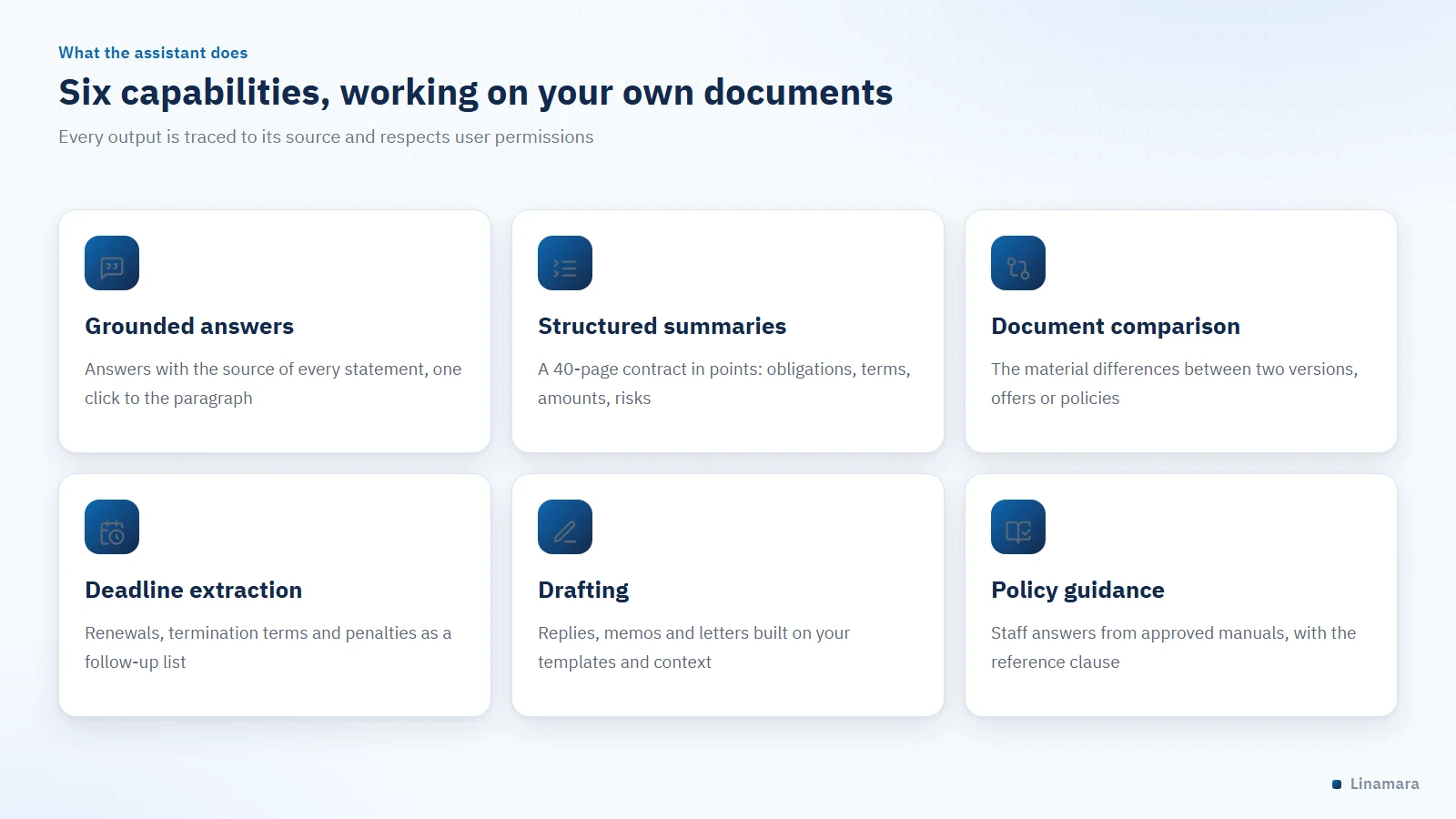
| Grounded answers | Answers questions about documents, policies and procedures, attaching its sources to every answer. One click takes you to the information in the original document, with the cited paragraph highlighted. |
| Structured summaries | Summarizes a forty-page contract, a technical report or a case file into points that highlight what matters: obligations, terms, amounts and risks. It can be pointed at a specific angle, such as the financial clauses alone. |
| Comparison | Compares two versions of a contract, two supplier offers or two versions of a policy, highlighting material rather than cosmetic differences — a task that takes hours of cross-reading, done in moments. |
| Deadline extraction | Extracts whatever requires action: renewal dates, termination conditions, penalties and guarantees — turning static text into an actionable follow-up list. |
| Drafting | Drafts replies, memos and official letters based on your previous documents and approved templates, so you start from a draft built on your context rather than a blank page. |
| Policy guidance | Answers staff questions about procedures from your organization’s approved manuals, with the reference clause — easing the recurring load on central departments and unifying how rules are applied. |
Source citation: how it works and why it matters
- Passage-level linking: every sentence is linked to the passage it came from, not to the document as a whole — so you reach the paragraph directly, not a sixty-page file.
- Precise location: the document name, page number and paragraph are shown, and highlighted when you open the source.
- Multiple sources when combining: when an answer is built from several documents, each source is cited next to the part that came from it.
- Date and version: the citation shows the document’s date and version, so decisions are never built on a cancelled copy or a superseded policy.
- Declining unsupported answers: what it cannot support from the archive, it does not say — no inference without a source and no filling gaps from general knowledge.
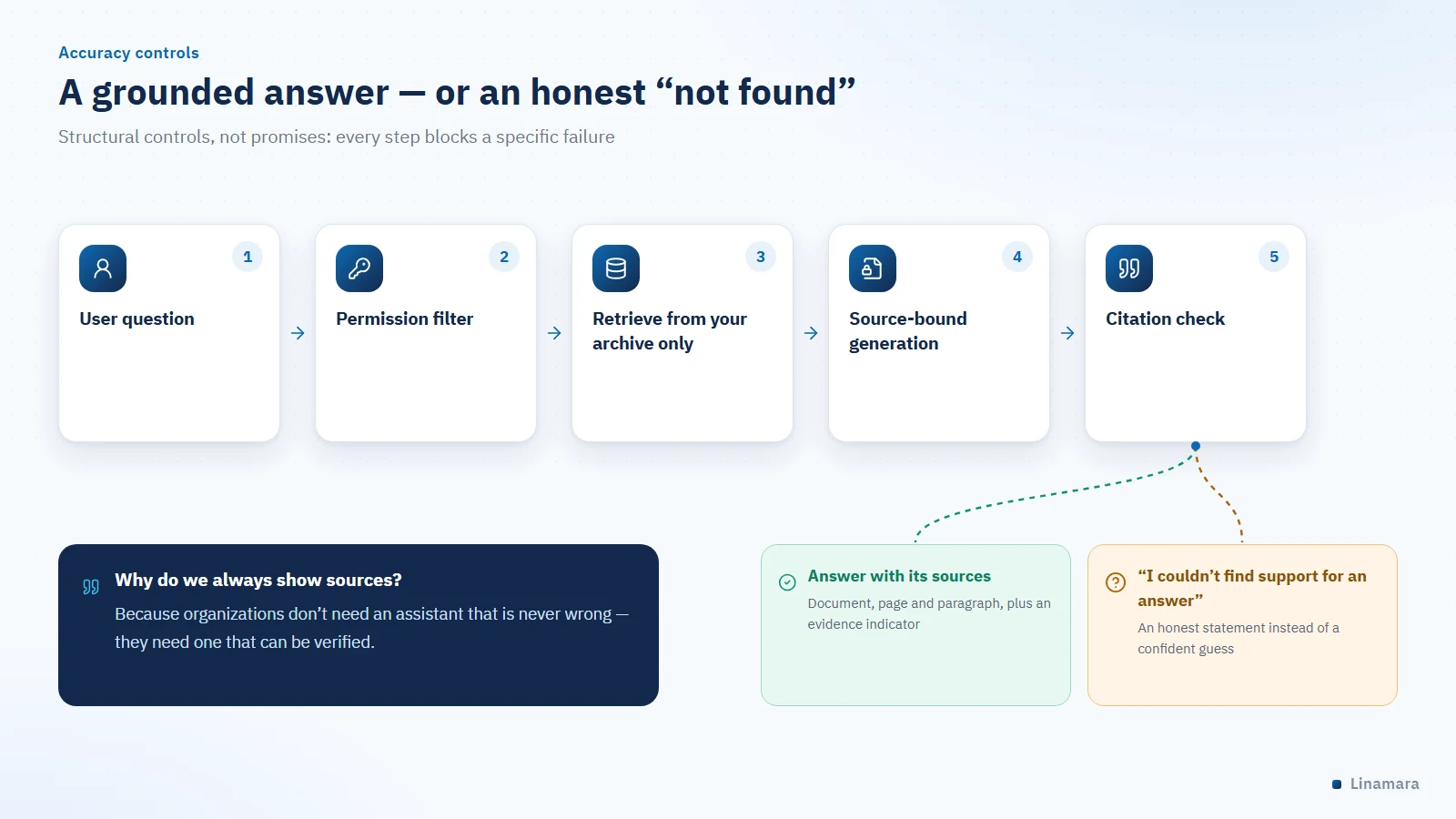
Why do we always show sources?
Because organizations don’t need an assistant that is never wrong — they need one that can be verified
Accuracy and reliability controls
| Control | How it is applied | What it prevents |
|---|---|---|
| Source-bound generation | Answers are written only from retrieved passages | Fabrication and mixing in general knowledge |
| Mandatory citation | No answer is shown without a source reference | Claims that cannot be verified |
| Admitting ignorance | An explicit statement when the archive holds no support | A convincing guess in a confident tone |
| Evidence indicator | Shows how strong the supporting evidence is | Overconfidence in sensitive decisions |
| Version and date awareness | Distinguishes the version in force from cancelled ones | Relying on a superseded policy |
| Scope limits | Declines questions outside the archive’s scope | Turning into an unreliable general reference |
| Human review | Sensitive outputs are presented for approval, not execution | Action without human oversight |
Permissions, privacy and deployment options
- Answers within the asker’s permissions: documents outside a user’s permissions never enter the search scope, so no information leaks from them, not even as a hint.
- Permissions inherited directly from the document management system with no double administration, plus a full query log for audit.
- Isolation from general training: your documents and questions are never used to train general models and never leave your organization.
- Fully on-premise: the model and retrieval engine on your servers — best for government bodies and sectors subject to data-sovereignty restrictions, and our recommendation.
- Hybrid: sensitive data in-house and general tasks outside — for those balancing performance and control.
- Private cloud: an isolated environment dedicated to your organization alone — for those who prefer less operational burden.
Full on-premise deployment is a real option today thanks to open language models that run on local infrastructure with performance suited to this use — without sending any data outside the organization.
The assistant on Think AI hardware: open models that learn your organization’s language
The local infrastructure meant here has a name: the Think AI hardware that Linamara provides. The ILM platform pre-installed on it runs open models and fine-tunes them on your documents and terminology with SFT, LoRA and QLoRA — on the same node that serves your users, so no separate training environment is needed. And because the assistant runs on a model you own, it can learn your organization’s language — something closed model APIs do not allow.
- UltraNode: the ideal choice when continuous training on your terminology is part of the plan.
- SuperNode: for an enterprise assistant serving every department from 384 GB of unified memory.
- MicroNode: for a department or branch assistant running quietly inside the office.
Arabic in the assistant experience
- Answering in the language of the question: ask in Arabic and get an answer in Arabic, even when the source document is in English.
- Sound institutional language: professional Modern Standard Arabic suitable for official use, not clumsy machine translation.
- Understanding mixed questions that combine Arabic with English terms.
- Internal terminology: training the assistant on your organization’s vocabulary and abbreviations so it understands your own naming.
- Hijri and Gregorian calendars, with conversion between them when needed.
- A genuinely Arabic, right-to-left interface in every element — not a partially translated English one.